Post
What is learning analytics and where is it going with artificial intelligence?
Editorial note: this text used generative AI for editing support; editorial responsibility remains with the author.
Learning analytics is a way to study what happens when a person learns by using data. In the definition popularized in 2011 by the community around LAK (Learning Analytics and Knowledge), an international conference on learning analytics, it is a field that measures, collects, analyzes and reports data about learners and their contexts in order to understand and improve learning and the environments where it takes place. Put simply: if a school, platform or course can observe certain signals from the learning process, it can better understand when someone is making progress, when they are stuck and what kind of support they may need.
It is not just about counting grades. Learning is not only passing an exam. It also matters whether a person participates, submits activities, views materials, asks questions, tries again after making a mistake or stops entering the platform for several days.
In a published systematic review on machine learning, generative artificial intelligence and learning analytics in higher education, we analyzed 101 empirical studies published between 2018 and 2025. The review shows that the field has grown substantially: predictive models became more established first, and more recently generative artificial intelligence has started to appear as a way to provide feedback, adapt activities and support educational decision-making.
What does it mean to analyze learning?
Imagine a student taking an online class. The platform can record when she logs in, which videos she plays, how long she takes to submit an assignment and where she participates most in the course. If those data are examined carefully, they can help answer questions such as:
- Which students may need support before failing?
- Which activities generate more participation?
- At what point in the course do more people disengage?
- Which resources seem to help students understand a topic better?
- What kind of feedback might be more useful?
That is learning analytics: using data to understand and improve learning. It is not enough to find patterns; those patterns also need to be interpreted and turned into useful action. The important point is that data should not be used to label a person unfairly, but to create opportunities for support.
Where do the data come from?
Data can come from many places. In digital courses, they often come from learning management systems such as Moodle, Canvas, Blackboard or similar platforms. These systems record activities such as entering the course, submitting assignments, answering quizzes, participating in forums or downloading materials.
Academic data can also be used, such as previous grades, attendance or progress through a study plan. In some cases, texts are analyzed: forum comments, open responses, course evaluations or feedback messages.
These data do not speak for themselves. A long pause in a video may mean that someone became distracted, but it may also mean that the student is thinking carefully about a difficult idea. That is why learning analytics needs context, human interpretation and clear educational questions.
More recent research also uses more complex data, known as multimodal data. These may include writing traces, video interaction, interface movements, audio, images or signals of collaboration. Such data can offer a more complete picture, but they also increase privacy risks. So the question is not only whether something can be measured, but whether it should be measured, with whose permission and for what purpose.
What can it be used for?
One of the most common uses is detecting academic risk. If a system observes that a person stopped participating, is not submitting activities or is showing repeated difficulties, it can send an early signal so that a teacher, tutor or advisor can provide support.
Another use is predicting performance. The goal should not be to say, “this person is going to fail”, but to identify early signals. If a problem is detected in week three of a course, there is still time to help. If it is detected only at the final exam, it may be too late.
Learning analytics can also improve feedback. Instead of receiving only a grade, a person can receive more specific comments: what they understood well, what they need to review and what the next step could be.
It can also help review entire courses. If many people make mistakes on the same topic, the problem may not be the students, but the explanation, the activity, the available time or the design of the course.
How has the field evolved?
For several years, learning analytics relied heavily on machine learning models. These models look for patterns in data. Some classify students by risk level, others predict outcomes and others group similar behaviors.
The field did not appear from nowhere. George Siemens, one of the researchers who helped define this field, shows that learning analytics has roots in several areas: citation analysis, social network analysis, user modeling, intelligent tutors, knowledge discovery in databases (finding patterns in large volumes of data), adaptive hypermedia (materials that adjust to each person) and online learning. In other words, it is not simply “using statistics in school”; it is a field that combines education, computing, system design and social sciences.
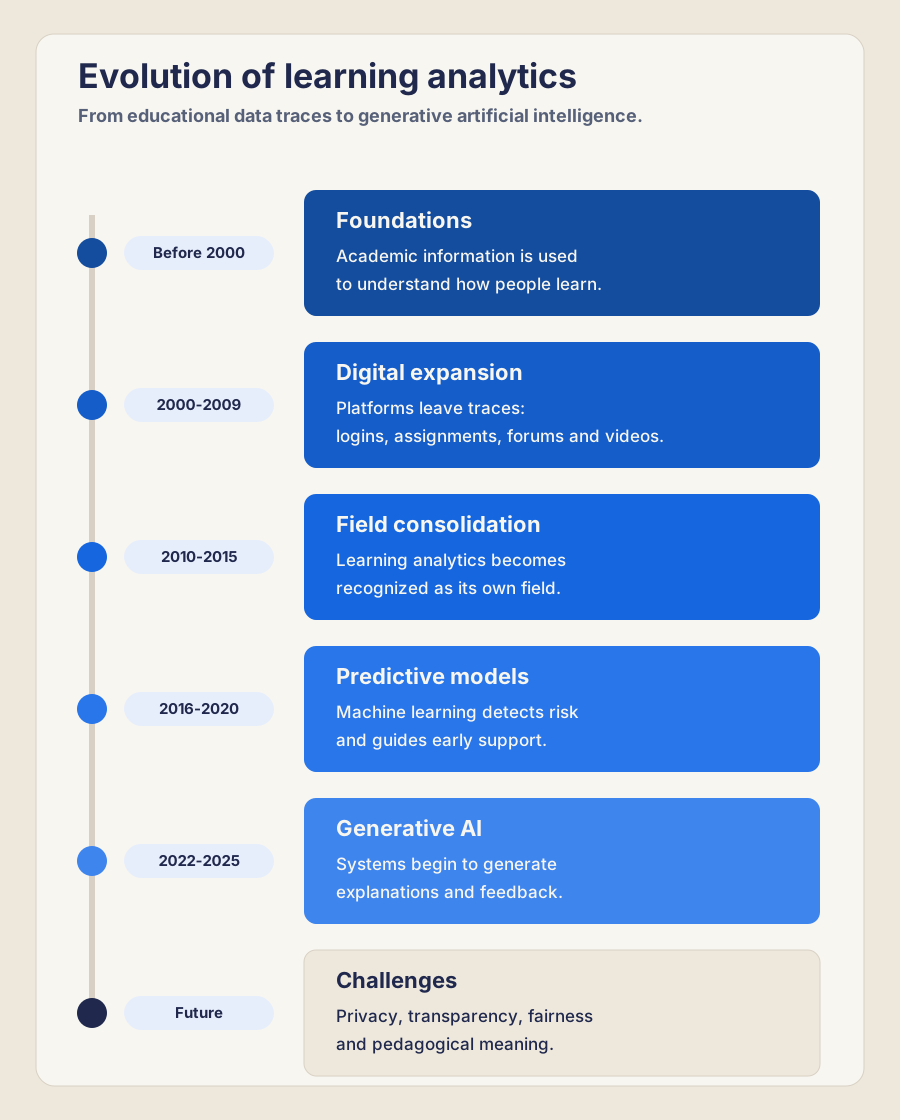
In the review, most traditional studies focused on three areas: academic performance prediction, dropout detection and engagement analysis. Many used models known as Random Forest, support vector machines, decision trees, logistic regression or neural networks.
These names may sound complicated, but the general idea is this: the system learns from previous examples and tries to recognize similar signals in new cases. For example, if in previous courses certain combinations of low participation, late submissions and poor quiz results were related to dropout, the system can detect similar cases in a current course.
The problem is that predicting is not the same as helping. A dashboard can say that someone is at risk, but if the institution does not know how to intervene, the data fall short. That is why the field is moving from a technical question to an educational one: not only “how accurate is the model?”, but “what can a person do with this information?”
What changes with generative artificial intelligence?
Generative artificial intelligence, such as language models, changes the picture because it does not only classify or predict. It can also generate text, questions, explanations, examples and feedback.
This opens interesting possibilities. A system could help a student understand why an answer is incomplete, suggest a way to study, propose a practice question or adapt an explanation to their level. It could also support teachers by summarizing participation patterns or identifying topics that need more attention.
But generative artificial intelligence is still experimental within learning analytics. The review shows considerable enthusiasm, but also important concerns. These systems can make mistakes, invent information or provide answers that seem correct even when they are not. They also often fail to explain clearly how they reached a recommendation.
That is why AI should not be understood as a replacement for teachers, tutors or students. It is more reasonable to see it as a support tool that must be supervised, well designed and connected to clear educational goals.
The most important challenges
The first challenge is privacy. Learning data reveal habits, difficulties, emotions, performance and context. They are not neutral data. They must be used with consent, care and clear rules.
The second challenge is data quality and scope. If we only look at what happens on a platform, we may miss an important part of learning: what happens in the classroom, in a conversation, in a notebook, at home or during an offline activity. A single type of data is rarely enough to understand such a complex process.
The third challenge is fairness. If a model is trained with data from certain countries, institutions or groups, it may work worse for people living in other realities. The review found that much research is concentrated in regions with more resources, while Latin America and other areas remain less represented.
The fourth challenge is transparency. If a system says that someone is at risk, the teacher and the student need to understand why. A prediction without an explanation can create mistrust or unfair decisions.
The fifth challenge is pedagogical: not reducing learning to what a machine can count. Useful feedback does not only correct; it also helps people think, revise, try again and gain autonomy. Learning also involves creativity, conversation, doubt, emotions, relationships and context. If analytics forgets that, it can become a form of control instead of a support tool.
Where is it going?
The future of learning analytics will likely be hybrid. On one hand, machine learning models will continue to be useful for detecting patterns, risks and trends. On the other hand, generative artificial intelligence can contribute interaction, explanation and more personalized feedback.
But the most important progress should not be only technical. The deeper question is human: how can we use technology so that more people learn better, with more support, more clarity and less inequality?
To achieve that, systems will have to be designed with teachers and students, not only for them. They will have to explain their recommendations, protect data, avoid bias and show that they actually help people learn.
Learning analytics should not become a sophisticated way of monitoring students. Its value lies in the opposite: detecting signals that used to go unnoticed and turning them into opportunities for support.
That is the most promising direction for the field: less obsession with predicting everything and more interest in building educational technology that is understandable, fair and centered on people.
This text is based on the systematic review Machine Learning and Generative AI in Learning Analytics for Higher Education and George Siemens’ article Learning Analytics: The Emergence of a Discipline.
Next step
Review publications
Connect this note with publications, academic profiles and reviewable sources.
Go to researchView applied work
Explore projects where these topics become software and user experience.
Go to workOpen a conversation
Use the public channels for academic, professional or research collaboration.
Go to contact