Post
One year after a systematic review on Learning Analytics and generative AI
Editorial note: this text used generative AI for editing support; editorial responsibility remains with the author.
One year is not enough to pronounce judgment on a field, but it is enough to see which questions start to remain. On 5 August 2025, Applied Sciences published a systematic review titled Machine Learning and Generative AI in Learning Analytics for Higher Education: A Systematic Review of Models, Trends, and Challenges. One year later, I want to return to it with some calm, not to celebrate a number, but to look at what has happened around a question that remains open: how can data and artificial intelligence support learning without losing sight of people?
According to Google Scholar, the review had already accumulated several dozen citations by August 2026. Beyond the number, that circulation is a good reason to return to it with a little distance: the topic is finding its way into conversations about personalization, feedback, prediction, understandable explanations and the ways students choose to use these tools.
One year is too short to close conclusions, but long enough to see which questions remain open, which tensions became more visible and how other works are beginning to use the review to think through new directions for the field.
What we reviewed
The review brought together studies on machine learning, generative AI and learning analytics in higher education. To do that, we followed PRISMA 2020 (a guide for reporting systematic reviews transparently), started from 9,590 records across 12 databases and included 101 studies published between 2018 and 2025.
That set of studies made it possible to look at two movements at once. On one hand, learning analytics with machine learning was already strongly present in tasks such as predicting performance, detecting dropout risk and analyzing student participation. On the other, generative AI was beginning to open more conversational uses: giving feedback, adapting explanations, supporting tutoring, analyzing text and helping with educational decisions.
What Still Holds
The first thing that still holds is that predicting is not the same as helping. A model can detect academic risk, but that does not mean an institution has the time, conditions or pedagogical criteria to intervene well. Learning analytics only makes sense when it connects to educational actions that are understandable, proportionate and fair.
It also still holds that generative AI does not erase the classic problems of the field. Sometimes it makes them more visible. If a system does not explain why it recommends something, if it uses data without enough context or if it ignores differences among students, it can look very advanced without necessarily being more responsible.
And there is one idea that remains central for me: the human dimension is not an add-on. Teachers, students, tutors and learning designers should not receive a prediction as if it were a closed truth. They should take part in deciding what is measured, how it is interpreted and what kind of support is acceptable.
What changed with generative AI
Generative AI moved part of the conversation. Learning analytics was often associated with dashboards, alerts or predictive models. Now it also includes the possibility of talking with data, generating feedback, adapting explanations or producing summaries for teachers and students.
Those possibilities are real, but so are the risks. Automated feedback can be useful when it appears at the right moment and within a well-designed activity. It can also confuse, be unfair or sound too confident if no one validates it with pedagogical criteria. The promise of personalization should not replace the responsibility to design good learning experiences.
Signals of progress in recent citations
Since the review was published, the field has not stood still. Looking at recent works that cite it, I do not see a single closed direction. I see more of a shift: less fascination with the model in isolation and more questions about how it is used, who can understand it and which educational decisions it can improve.
AI-based personalization, for example, is increasingly discussed as a broad educational issue, not only as an attractive platform feature. A global review in Social Sciences & Humanities Open uses the article while discussing advances and opportunities in AI-based personalized learning. The deeper question there is not whether we can show each student a different path, but what kind of support a student needs, with which data and under which criteria.
The relationship students build with these tools is also becoming more visible. An article in Computers and Education Open studies ethical and behavioral factors that influence students’ intentions to use ChatGPT in higher education. That line of work is valuable because it changes the focus: it is not enough to ask what the tool can do; we also need to ask how students understand it, when they use it and what effects it has on how they learn.
Feedback is another important area of progress. A meta-analysis in Educational Psychology Review reviews the effects of AI feedback on self-regulated learning, that is, on students’ capacity to plan, revise and regulate their own learning process. This helps keep the conversation grounded: it is not enough for a system to write a convincing response; we need to know whether that response helps students learn better.
Academic risk prediction is also moving closer to educational intervention. A Scientific Reports article studies dropout risk in technical education using Moodle data. What is interesting is not only anticipating who might need support, but thinking about how to turn that signal into early alerts, guidance and clearer curriculum decisions.
Finally, the need for systems to explain what they recommend is gaining weight. Another Scientific Reports article proposes a framework with SHAP and LIME to predict student success in online environments. SHAP and LIME are two methods for explaining which variables carry weight in a prediction. The public question is simpler: if a system predicts something about a person, can we understand why it says so and discuss what to do with that information?
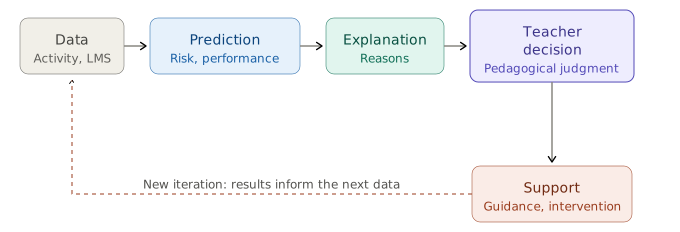
Taken together, these citations suggest that the most interesting progress is not only in having more powerful models. It is in connecting personalization, student use, feedback, prediction, explanation and institutional responsibility.
That point also connects with the direction I am most interested in pursuing: moving from models that only describe or predict toward systems that help people make better decisions, with teachers at the center and explanations that can be discussed.
What I do not want to lose sight of
One year later, I see the review as a way to organize questions, not as a final answer. The field moves quickly, and every synthesis ages. Even so, some questions remain necessary:
- What educational decisions does an analytics system actually improve?
- Who can understand and challenge an algorithmic recommendation?
- Which data are legitimate for supporting learning, and which data go too far?
- How is pedagogical impact evaluated, not only technical accuracy?
- What conditions do institutions need in order to use these systems without increasing inequality?
The direction that interests me most is not more sophisticated learning analytics for monitoring students. I am more interested in educational technology that can make useful signals visible in order to support people better. In other words: analytics should not end in an alert, but in a better informed conversation about how to support the person who is learning.
Further reading
If you want a broader introduction to the topic, I also wrote about what learning analytics is and where it is going with artificial intelligence. You can also visit the research section, where there is a direct link to the published systematic review.
Some recent works that help situate those developments include:
- Fortuna, A., Prasetya, F., Samala, A. D., Rawas, S., Criollo-C, S., Kaya, D., Raihan, M., Andriani, W., Safitri, D., & Nabawi, R. A. (2025). Artificial intelligence in personalized learning: A global systematic review of current advancements and shaping future opportunities. Social Sciences & Humanities Open, 12, 102114. https://doi.org/10.1016/j.ssaho.2025.102114
- Rizun, N., Bordean, O. N., Nikiforova, A., Beleiu, I. N., & Revina, A. (2026). Generative AI in higher education: Ethical and behavioral factors influencing students’ intentions to use ChatGPT. Computers and Education Open, 10, 100336. https://doi.org/10.1016/j.caeo.2026.100336
- Huang, C.-Q., Lu, L.-N., Huang, Q.-H., Zhang, Y.-R., He, T., Tu, Y.-F., & Hwang, G.-J. (2026). Effects of artificial intelligence feedback on students’ self-regulated learning in higher education: A three-level meta-analysis. Educational Psychology Review, 38(1), 64. https://doi.org/10.1007/s10648-026-10166-z
- Ovtšarenko, O. (2026). Using AI to forecast student dropout risk in technical education using a learning analytics approach. Scientific Reports, 16(1), 14616. https://doi.org/10.1038/s41598-026-44919-1
- Almazroei, E. E. (2026). Ensemble machine learning framework with SHAP and LIME for accurate early prediction of student success in online learning environments. Scientific Reports, 16(1), 19506. https://doi.org/10.1038/s41598-026-49894-1
Next step
Review publications
Connect this note with publications, academic profiles and reviewable sources.
Go to researchView applied work
Explore projects where these topics become software and user experience.
Go to workOpen a conversation
Use the public channels for academic, professional or research collaboration.
Go to contact