Post
Why the first minute matters
Editorial note: this text used generative AI for editing support; editorial responsibility remains with the author.
A video game can have an interesting idea, a strong mechanic, and a careful visual style—and still lose a player before the experience really begins.
The first minutes are fragile. A player is still working out what they can do, what the system expects, what counts as progress, and whether an error is part of learning or a sign that the game has failed to explain itself. If a game asks too much too soon, it can confuse. If it explains too much, it interrupts. If it explains nothing, it can leave the player outside the experience.
That is why the first minute is not a formality. It is a design decision.
In the previous post, I argued that game design starts by asking who we are designing for. That question needs a second one: once we know what kind of experience we want to offer, how do we check whether the game lets someone enter it?
GAP and PLAY offer two useful sets of questions. They help us examine whether a game gives a player a legible way in and whether the experience it promises can be sustained through play.
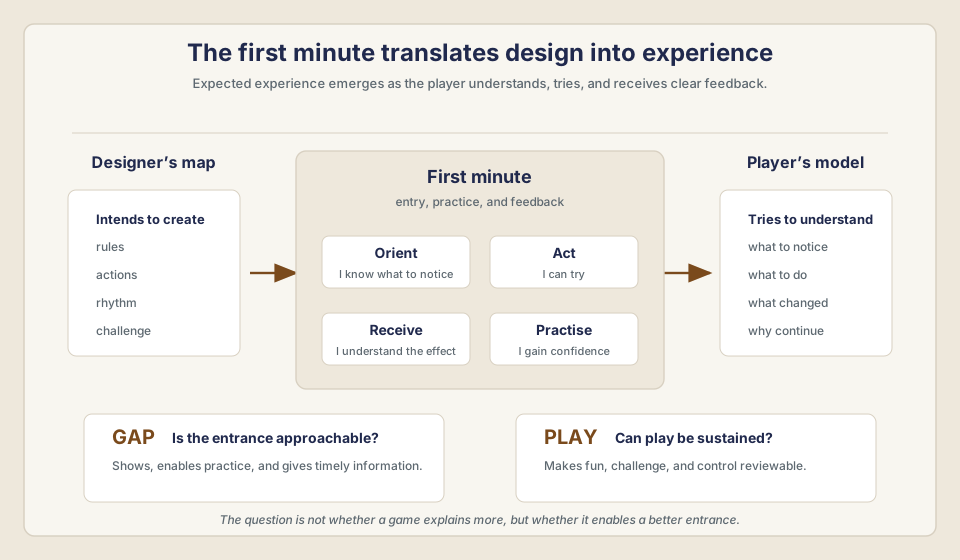
A game begins before someone plays well
When someone opens a game for the first time, they are reading signals. They test controls, interpret goals, measure consequences, and decide whether they understand enough to continue. In doing so, they build a mental model of the game: what matters, what actions are possible, what risks exist, and what kind of attention the game demands.
A designer has a much fuller conceptual model of the system. The player reconstructs it gradually from what they see, try, and receive in return. The problem appears when that distance prevents meaningful action. Then a player does not fail because the challenge is interesting; they fail because they do not yet understand what game they are playing.
MDA helps name part of this gap. It distinguishes the mechanics a team builds, the dynamics that emerge when those mechanics operate, and the experience a player perceives. A player does not receive a technical list of rules; they interpret what those rules allow, demand, and make them feel.
GAP: protecting the entrance
GAP—Game Approachability Principles—asks whether a game lets people in. Its concern is whether someone can approach it, learn the basics, and gain enough confidence to keep playing. Every game invents part of its own language. Even an experienced player has to learn which buttons matter, which rules change, and what deserves attention in that world.
GAP turns this concern into practical questions:
- Does the game show before it demands?
- Can a player practise an action before being punished for it?
- Does information arrive when it is needed?
- Does feedback make clear what just happened?
- Does the opening build confidence, or only measure mistakes?
In class, I often use Plants vs. Zombies as an example that, in my view, handles this well. It does not explain its whole system at once. It first presents a clear space, a recognizable threat, and one basic action: placing a plant to stop a zombie. Learning already feels like playing: a small rule can be practised, feedback arrives quickly, and the rhythm of the system becomes visible before more combinations appear.
PLAY: examining what play feels like
PLAY shifts attention to the lived experience of playing. It asks whether a game communicates clear goals, offers useful feedback, maintains an appropriate rhythm, gives sufficient control, remains consistent, and creates an experience the player can recognize as meaningful.
The product of game design is not only a file, a screen, or a set of rules. It is an experience formed in each player’s mind. Challenge, curiosity, relaxation, frustration, and mastery will not be identical for everyone. That makes evaluation uncomfortable, but necessary: what we do not observe carefully is hard to discuss, and what we cannot discuss precisely is hard to improve.
PLAY gives us observable signals that can support or disrupt an experience: clarity of goals, control, feedback, consistency, pace, challenge, and system response. GAP focuses on crossing the threshold; PLAY focuses on what happens once the player is inside. They complement each other.
A heuristic is not a recipe
There is a risk in using heuristics: treating them as a mechanical checklist. Checking boxes can feel reassuring, but it does not automatically produce better design. Heuristics are most useful when they make a conversation more precise. They can anticipate obvious problems and improve an early prototype, but they do not replace watching real people play.
That is why GAP and PLAY work best alongside observation and usability testing: before a session to remove obvious friction, between iterations to review decisions, and afterward to interpret what happened.
An exercise for the first minute
One useful exercise is to look at only the first minute of a game. Ask what the player thinks they need to do, which action they learn first, where they can practise without feeling punished, what feedback they receive, and what GAP or PLAY would identify. That restriction turns an abstract conversation into concrete design: a doorway, a button, a camera, a sound cue, or a visible consequence.
The first minute does not determine the quality of an entire game, but it reveals a great deal about its design stance. Designing it is not about making a game simpler. It is about making it possible for someone to want to stay.
Further reading
- Desurvire, H., Caplan, M., & Toth, J. A. (2004). Using heuristics to evaluate the playability of games. CHI Extended Abstracts 2004, 1509–1512. https://doi.org/10.1145/985921.986102
- Desurvire, H., & Wiberg, C. (2010). User experience design for inexperienced gamers: GAP – Game Approachability Principles. In Evaluating User Experience in Games (pp. 131–147). Springer. https://doi.org/10.1007/978-1-84882-963-3_8
- Desurvire, H., & Wiberg, C. (2015). User experience design for inexperienced gamers: GAP – Game Approachability Principles. In Game User Experience Evaluation (pp. 169–186). Springer. https://doi.org/10.1007/978-3-319-15985-0_8
- Santana-Mancilla, P. C., Gaytán-Lugo, L. S., & Rodríguez-Ortiz, M. A. (2016). Usability testing of serious games: The experience of the IHCLab. In Games User Research: A Case Study Approach (pp. 271–283). CRC Press. https://www.taylorfrancis.com/chapters/edit/10.1201/b21564-20/usability-testing-serious-games-experience-ihclab
Next step
Review publications
Connect this note with publications, academic profiles and reviewable sources.
Go to researchView applied work
Explore projects where these topics become software and user experience.
Go to workOpen a conversation
Use the public channels for academic, professional or research collaboration.
Go to contact