Post
Designing games from player motivation
Editorial note: this text used generative AI for editing support; editorial responsibility remains with the author.
A video game is not fully designed in the code, on the screen or in the design document. It finishes taking shape when someone plays it, interprets it and decides whether that experience makes sense to them.
That idea sounds simple, but it changes the way we design. If the experience happens in the player’s mind, then one question has to come before many others: who are we designing for?
It is not enough to say “for players.” It is not enough to say “so it is fun.” Fun is not a universal substance added at the end. What grips one person can leave another indifferent. A game can be very well made and still say nothing to us. Not because it fails technically, but because it was not built for our motivations, habits, patience or way of enjoying play.
That is why designing games is not only about inventing mechanics. It is also about carefully imagining what kind of mental, emotional and social experience will sustain someone’s desire to play.
The problem with designing for everyone
In class, I often return to an uncomfortable idea: a game is not for everyone. It can be accessible to many people, welcome different players and offer several layers of meaning. But if it tries to excite everyone equally, it risks exciting no one in particular.
Design requires choosing. If a game privileges challenge, it may need to accept some friction. If it privileges relaxation, it may need to avoid punishing every mistake. If it seeks exploration, it needs space, curiosity and enough signs so that getting lost does not become the same as giving up. If it seeks competition, it needs clear rules, fair comparison and precise feedback.
Each decision strengthens one experience and weakens others. That is not a flaw in design; it is part of design.
For a long time, several tools helped frame this problem through relatively compact models. Bartle proposed a well-known taxonomy of four player types: achievers, explorers, socialisers and players who compete with or dominate others. The MDA framework, associated with Hunicke, LeBlanc and Zubek, helped distinguish between mechanics, dynamics and aesthetics: what the designer builds, what happens when the system starts moving and what the player perceives as experience.
These models remain useful because they organize a difficult conversation. But they also simplify. Sometimes too much.
From player types to dimensions
The article by McKechnie-Martin, Cunningham, Baumeister and Von Itzstein offers a finer view. In A Meta-Ethnography of Player Motivation in Digital Games: The 28 Dimensions of Play, the authors review the literature on motivation in digital games and synthesize 332 concepts from 36 studies into a framework of 28 dimensions of play.
What matters is not only that the number is larger. What matters is the shift in perspective. Instead of placing the player inside a fixed category, the paper proposes thinking of motivations as dimensions that may appear with different levels of intensity.
A player does not have to be only an “explorer,” “competitor” or “socialiser.” They may seek technical competence, enjoy narrative, avoid suspense, value cooperation and want to customize an avatar at the same time. Another player may share two of those motivations and reject the rest. The map becomes more complex, but also more honest.
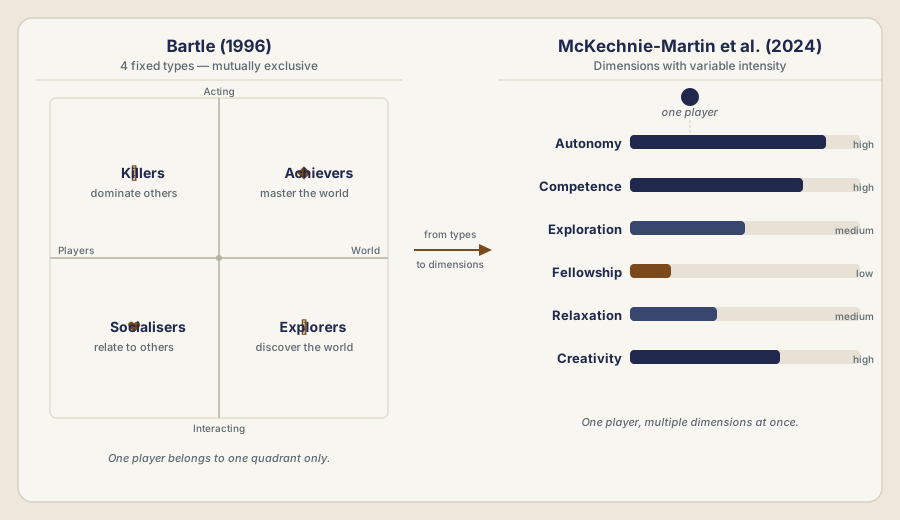
Among the dimensions synthesized in the article are autonomy, competence, cooperation, creativity, exploration, expression, fantasy, fellowship, growth, relaxation, sensation, status, story, strategy and thrill, among others. They are not a list of ingredients that every game should use. They are a vocabulary for making better decisions.
That is one of the most useful lessons for design: a dimension is not a feature. The fact that a motivation exists does not mean it has to be inserted into the game. A small game may become clearer if it chooses two or three central motivations and works them well, instead of trying to cover the whole map.
What changes for design
Thinking in dimensions forces us to ask more precise questions.
Not only: is my game casual or hardcore?
Also: what kind of attention does it ask for? What level of frustration does it tolerate? What rewards matter? Does the player want to master a system, inhabit a story, spend time with others, express themselves, relax or measure their skill against someone else?
These questions affect the entire structure of the game. They affect the core loop, the difficulty curve, the rhythm of sessions, the interface, reward systems, level design and even the platform.
If someone plays for strategy, they may need time to observe, compare, anticipate and correct. If they play for sensation or adrenaline, they may need fast responses, visible consequences and constant stimulation. If they play for fellowship, the system has to care about how cooperation is organized, how shared progress is communicated and what kinds of relationships it allows between players.
Motivation does not live apart from mechanics. It becomes cognitive, emotional and social demand. That is why designing for someone does not mean imagining a decorative profile, but building a coherent relationship between player, mechanics, rhythm and structure.
Centering the player is not pleasing everyone
Centering the player does not mean obeying every preference. It also does not mean turning design into a survey of tastes. It means recognizing that the game is an incomplete artifact until someone plays it.
Empathy in design is not assuming that everyone will enjoy what I enjoy. It is the effort to look from another way of playing: what the player understands first, what feels fair, what sparks curiosity, what becomes tiring, what gives them pride and what makes them want to return.
That effort also has limits. McKechnie-Martin et al. themselves warn that the 28 dimensions do not yet translate directly into market outcomes or production-ready decisions. They also note that the reviewed literature depends heavily on English-language publications and Western contexts. In other words, the framework helps us think, but it does not replace observation, playtesting or design judgment.
That matters. A model does not design for us. It gives us better questions.
Designing a situated experience
When a student starts designing their first video game, the temptation to accumulate ideas often appears: more mechanics, more enemies, more story, more modes, more rewards. But a game does not improve just because it has more things. It improves when its parts work together to sustain a clear experience.
That is why one practical question may be more useful than a list of features:
What motivation do I want to care for first?
If the answer is exploration, the design has to protect curiosity. If the answer is competition, it has to protect the fairness of the challenge. If the answer is relaxation, it has to protect rhythm and low tension. If the answer is creativity, it has to protect the freedom to try things without unnecessary punishment.
A simple exercise helps turn this into practice: pick two or three dimensions from the list and, for each one, write down how it should shape the core loop, the difficulty curve, the feedback and the interface. If a design decision does not clearly serve one of those chosen dimensions, it is probably decoration, not design.
The 28-dimensions paper does not make design more complicated for its own sake. It makes it more precise. It reminds us that play does not mean one single thing and that “the player” is not a universal category. The player is a situated person, with motivations that combine, change and sometimes contradict one another.
Designing games from the player does not mean building a world for everyone. It means building an experience clear enough for someone, and careful enough for other people to find their own way in.
Further reading
This text is based mainly on:
- McKechnie-Martin, C. T., Cunningham, A., Baumeister, J., & Von Itzstein, G. S. (2024). A meta-ethnography of player motivation in digital games: The 28 dimensions of play. Games and Culture, 21(2), 167–191. https://doi.org/10.1177/15554120241242332
- Hunicke, R., LeBlanc, M., & Zubek, R. (2004). MDA: A formal approach to game design and game research. Proceedings of the AAAI Workshop on Challenges in Game AI, 4(1), 1–5. https://cdn.aaai.org/Workshops/2004/WS-04-04/WS04-04-001.pdf
- Bartle, R. (1996). Hearts, clubs, diamonds, spades: Players who suit MUDs. Journal of MUD Research, 1(1), 1–19. https://mud.co.uk/richard/hcds.htm
Next step
Review publications
Connect this note with publications, academic profiles and reviewable sources.
Go to researchView applied work
Explore projects where these topics become software and user experience.
Go to workOpen a conversation
Use the public channels for academic, professional or research collaboration.
Go to contact